Post-operative rehab
The weeks after surgery decide the result.
Read more about Post-operative rehabPhysiotherapy in Parktown North
Getting the pain to stop is the easy half. The part that decides whether you are back here in three months is what happens between feeling better and being genuinely ready to load it again.
Does this sound familiar
More on specific problems

What happens
Every patient is different, but the shape of the work is consistent — and you will always be told what is happening and why.
The painful tissue is often not the problem — it is the part that gave in first. Assessment covers the whole chain, plus your training load and what changed before it started.
Hands-on treatment, dry needling, taping and a sensible plan for training in the meantime. Complete rest is rarely the right answer.
Progressive, measured loading. Strength, control and tolerance built back to the demands of your actual sport, not to a generic milestone.
You go back when the leg or shoulder can do the work, tested — not when the calendar says the injury should be healed.
Worth knowing
A sports practice reflects its catchment, and this one sits in the middle of a very active few square kilometres. The Braamfontein Spruit runs north from Emmarentia through Parkhurst and Craighall Park into Delta Park, and it is dirt, grass, gravel and granite rather than tar. Delta parkrun goes off at eight every Saturday over five kilometres of mostly grass with rutted sections. Marks Park in Emmarentia fields cricket, rugby, soccer and tennis; Pirates in Greenside runs a weekly time trial alongside hockey and rugby; and the Westcliff stairs are climbed as a training session by people who live at the bottom of them.
That mix produces a recognisable set of problems. Uneven ground asks far more of the foot, calf and hip than a road does, so ankle sprains and Achilles complaints are over-represented. Weekly time trials and parkruns concentrate load into a single hard effort on a body that has done nothing similar for six days. And stairs — particularly coming down them — are one of the most demanding things a knee does all week.
Johannesburg sits at roughly 1,750 metres, which is worth a mention for anyone new to the city or returning from the coast. Efforts feel harder at altitude for the first few weeks, and the usual mistake is not adjusting the training, deciding something is wrong, and then adding a session to fix it.
Worth knowing
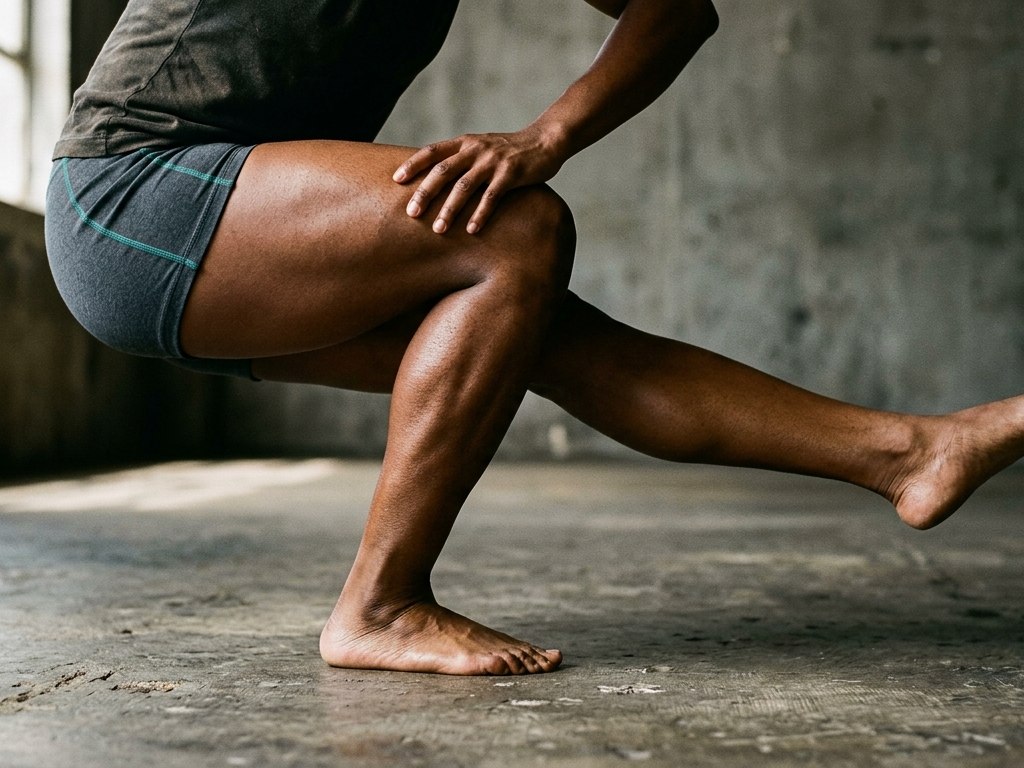
Iliotibial band syndrome is the most common cause of pain on the outside of the knee in runners. It is an overuse problem, usually linked to weak or poorly recruited gluteal muscles, a jump in mileage, or a lot of downhill. Most cases respond to conservative treatment — load management plus targeted strengthening — over something in the order of four to eight weeks.
Patellofemoral pain is the ache at the front of the knee that is worse on stairs, on hills and after sitting still. It accounts for a substantial share of all knee complaints, and treatment centres on quadriceps and hip strength, movement retraining and sometimes taping.
Achilles tendinopathy is the one most often mismanaged, because the instinct is to rest it and rest is precisely what does not work. Tendons respond to graded loading. Reported recovery for most cases sits around three to six months, and longstanding cases can take closer to a year — which is unwelcome news, and much better delivered at the start than at month four.
Hamstring strains are graded by severity, and the reported return-to-sport ranges are roughly one to three weeks for a mild strain, three to eight weeks for a partial tear, and three to four months where the internal tendon is involved. The most important number, though, is this: a previous hamstring injury is the single strongest predictor of the next one, which is why return should be decided on testing rather than on the calendar.
Rotator cuff and shoulder pain from swimming, racquet sports, throwing or overhead gym work is the fifth. For degenerative cuff pain in particular, a properly progressed loading programme is a serious treatment option rather than a holding pattern before surgery.
Worth knowing
The last third of a rehabilitation is where re-injuries are made. Pain settles well before capacity comes back, and an athlete who feels fine at six weeks will happily load a structure that is nowhere near ready.
So the exit criteria are measured rather than assumed: strength compared side to side, control under fatigue, tolerance of the specific movements your sport demands, and the ability to do them repeatedly rather than once. If the leg cannot do the work, the date does not matter.
That is also the honest reason a rehabilitation sometimes runs longer than a patient wants. Finishing it properly is considerably quicker than doing it twice.
Worth knowing
After qualifying at Stellenbosch in 2011 and eighteen months in practice in Hoedspruit, Rikki deliberately specialised into sports and orthopaedic rehabilitation. It has been the core of the practice ever since — club athletes, weekend runners, and people who simply want their body to keep up with what they ask of it.
Before you book
Rarely complete rest. For most overuse injuries — and tendon problems in particular — total rest lets the tissue lose what capacity it had, so the pain returns the moment you start again. The usual answer is modified training: keep the volume you can tolerate, remove the specific thing that provokes it, and add loading that rebuilds the failing part.
What that looks like in practice depends on the diagnosis, which is the point of the first appointment.
It depends entirely on what is wrong, and the honest ranges vary a great deal — a mild calf strain and an Achilles tendinopathy are not the same conversation, and one may be weeks while the other is months.
What you will get at the first appointment is a realistic estimate and the criteria you will need to meet, rather than a date pulled out of the air. If the estimate turns out to be wrong, it gets revised out loud.
Usually not. Most sports injuries are diagnosed from the history and a physical examination, and imaging is reserved for cases where it would genuinely change the plan — a suspected significant tear, a possible stress fracture, or an injury that is not behaving as expected.
If that is where you are, Rikki will tell you and point you at the right person rather than treating around it.
Usually because the first rehabilitation stopped when the pain did. Pain resolves well before strength, control and tissue tolerance do, and returning at that point means loading a structure at perhaps seventy per cent of what the sport asks of it.
With hamstrings especially, a previous injury is the strongest known predictor of the next one, which is exactly why the last phase of the programme is the one worth finishing.
Yes, and they are a regular part of the week during term — hockey, rugby, netball and athletics in particular. Growing athletes are not small adults: growth plates, rapid changes in height and the sheer volume of school fixtures create injury patterns that are specific to that age group and are frequently played through.
Also treated here
The weeks after surgery decide the result.
Read more about Post-operative rehabThe ache that has been there for months, and the one that arrived overnight.
Read more about Neck & back painNext step
Book online at any hour, or send a WhatsApp if you would rather describe the problem first and be told honestly whether physiotherapy is the right call.